MBC’s Andrea Potts sat down with Emma Mincks to discuss colonial histories of teeth.
Dr. Emma B. Mincks is a mixed-heritage scholar researching the connections between the commodification of the body and its parts to the commodification and enclosure of land in the 18th and 19th century. They work as part time faculty in Women, Gender, and Sexuality studies at the University of New Mexico in Albuquerque, United States.
Andrea: What is the focus of your research?
Emma: I study British colonialism broadly and more specifically, I have been researching representations of teeth in the archives, especially in late eighteenth and early nineteenth century Britain, Ireland and the United States. A theme that emerges is that writers were using their colonial gaze to interpret the character of colonised peoples through their teeth. I’m particularly focusing on Irish working-class women and Indigenous people from North America.
Andrea: Tell me more about this connection between teeth and reading the character of a person.
Emma: I started noticing this pattern in literature and travel narratives first, where an author would talk about the whiteness of the teeth of someone they encountered, the pearliness or the ‘purity of their teeth’. And these descriptions were appearing really early on these texts. And it seemed to be connected to ideas of sexual purity and the perceived purity of their land resources and the place they were from. Most of the people who are being examined through their teeth are land-based people. So, they’re either agricultural workers, poor working-class peasants or members of an Indigenous tribe who had land-based spirituality. And these people were not eating the same diet as people in Imperial Britain, especially London’s upper classes. From the eighteenth century, British people had more access to goods that were imported through colonialism, including sugar and tea, which were damaging their teeth. So, the teeth of colonised peoples were being highly valued, which I found really interesting. But alongside this, the land that these people were working and living on was being dispositioned under the guise of being ‘wasted land’.
Now, this notion of determining someone’s sexual character through their teeth is older than the eighteenth and nineteenth centuries. But it takes on a new character in being connected to colonial land resources. So, comparing teeth to ivory, for example. There was a connection to the goods that were being brought back from the colonies. The way in which the teeth of colonised peoples were described gradually changed over time. So, at first descriptions praised their purity and whiteness, alongside the purity of peoples’ character. But as the dispositioning of land intensifies – for example, as Indigenous people are put on reservations in North America – there is an increased fetishisation of colonised peoples’ teeth and a market in extracting people’s teeth to sell them. So, now, the teeth are the only important element of a person, as a commodity.
And there was a market for human teeth, you know. The spoils of colonisation were rotting peoples’ teeth. There was a growing self-consciousness around teeth from the late eighteenth century due to overconsumption of sugar and a lack of dentistry. So, there were live tooth transplantations taking place. So, teeth would be extracted and put into the socket of a wealthier person, and that would last for about 2-4 years if it didn’t give them a horrific infection.
Andrea: Oh dear.
Emma: And, you know, the appearance of these people would then be marred. Another strand to this is that with the rise of colonial conquest, teeth would be taken from bodies and sent back to be made into dentures in London. So, all of these practices are a reflection that racialised and colonised peoples were seen as just body parts that could be used and extracted. It wasn’t just about, you know, extracting labour from them, it was also about literally removing the parts of their body that they valued. This was also happening with working-class communities in Britain, so its also about class and economic security.
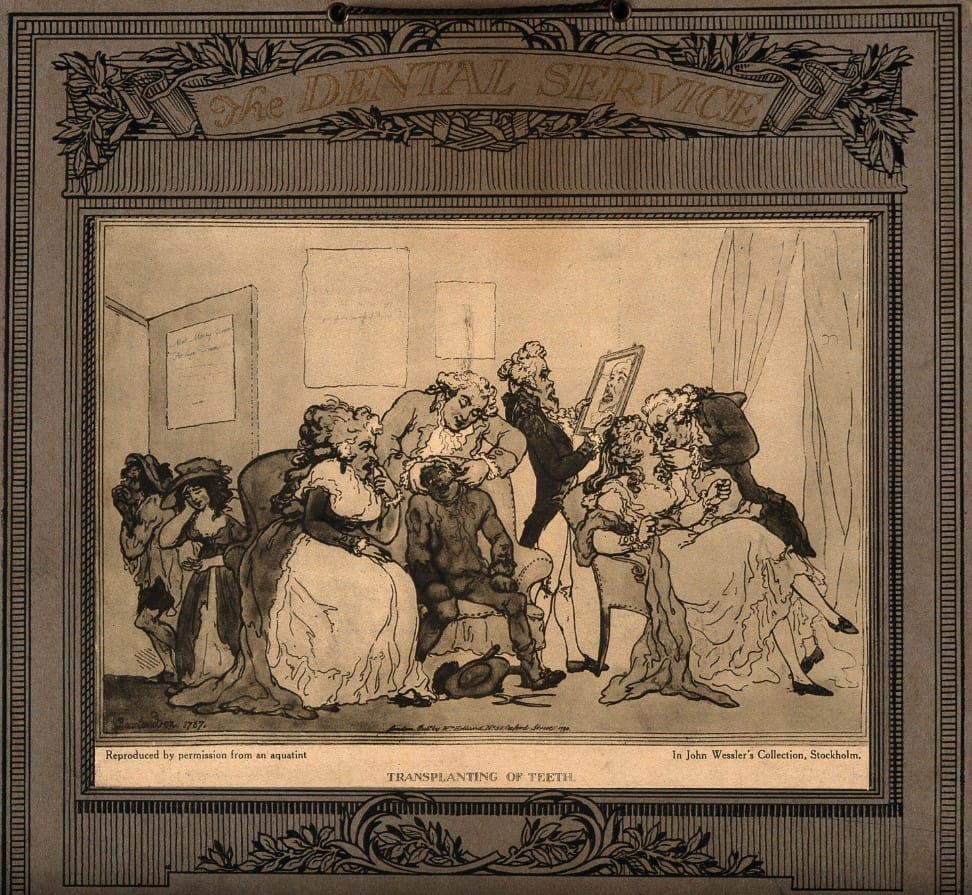
Andrea: This is disturbing. You can probably tell from my facial expressions. This dismissal of these people as less than in so many ways, but alongside this idealisation of their teeth, which results in a practice of just removing that element for their own use.
Emma: It is really disturbing.
Andrea: Has this been a difficult subject to research? I’m thinking about the emotional impact of encountering this kind of material.
Emma: It was really upsetting to research, honestly. It’s kind of traumatising to even look at it, but then also to realise how pervasive this was. The dehumanisation. People are described through their body parts. It was really shocking to read.
Andrea: I’d love to know more about your research journey.
Emma: So, first of all, I studied abroad in England as an undergraduate. And I realised that in the United States, we are pretty obsessed with our teeth. And alongside that, I had my own traumatic experience. So, I had oral cancer as a child, which was caused by radiation exposure in South Dakota. And I remember that the doctors were excited to examine this rare cancer that I had. I’d be sitting there with my mouth open for hours at a time. So, when I started to read about working-class, Indigenous and African people who were having their teeth examined, extracted, and studied, something connected. It was a really strange experience.
Andrea: I’m interested in the emotional labour that goes into this kind of work.
Emma: Yeah, and that’s kind of what I love about research, the emotional nature of it. Although at times, I do have to take a break from looking at the documents. All this medical stuff that I experienced, they were doing that to people way back when. And its not just in my head, these experiences of objectification or sexualisation that I experienced as a child medical patient. And there have been instances when I’ve been researching when, you know, you feel it, you feel it in your body.
And you know, a lot of these practices are still with us today. Something that shaped by research a lot is the fact that my sister-in-law, who is Lakota – she’s Cheyenne River – she had to go to the dentist when she was pregnant with my nephew. And he pulled out four of her wisdom teeth without anaesthesia and she was so mad about it, and rightly so. And the dentist was sexually harassing her for weeks afterwards. As a white settler, I never experienced that. Hearing my sister-in-law’s story about her teeth and how she’s been fetishised as a native person in the US by medical professionals made me want to write about this topic more. It became clear to me that we need to talk about this.
Andrea: Yes, it’s still impacting peoples’ lives.
Emma: Anytime we look at the past, even though we don’t quite understand some of it, it is important to connect it to continued injustice because colonialism and settler colonialism are still ongoing. The commodification of land and the body is ongoing.