MBC’s Andrea Potts sat down with Awuor Onyango to discuss her artistic practice, which explores how definitions of womanhood have been imposed, internalised and challenged in colonial and post-colonial Kenya.
Awuor Onyango is a Kenyan multidisciplinary artist and writer whose work explores how archives, images, and inherited memory shape African identities. Working across video, installation, film, photography, painting, writing and zine-making, she interrogates the systems that construct Black womanhood and knowledge. Her current project, Library of Silence: Lawino, examines how African women’s voices have been shaped, silenced, and reimagined.
Andrea: What is the focus of your artistic practice?
Awuor: I’m a multi-sensorial artist, researcher, curator and writer based in Nairobi. I’m part of an arts organisation called African Art Agenda that works across art, architectural design and archives, because we came to the conclusion that the Kenyan understanding of art is much wider than a Western understanding of art. So, we work in a cross-disciplinary sense. I’m interested in ideas of re-matriation, which is this idea of coming back into the feminine. And I’m very interested in how the feminine is constructed and observed. So, I explore how the African feminine, the Kenyan feminine and the Luo feminine – that’s the ethnicity that I come from – ends up always being contrasted against British settler colonial ideas of the feminine. The British set out what it means to be a woman, both in public and in private.
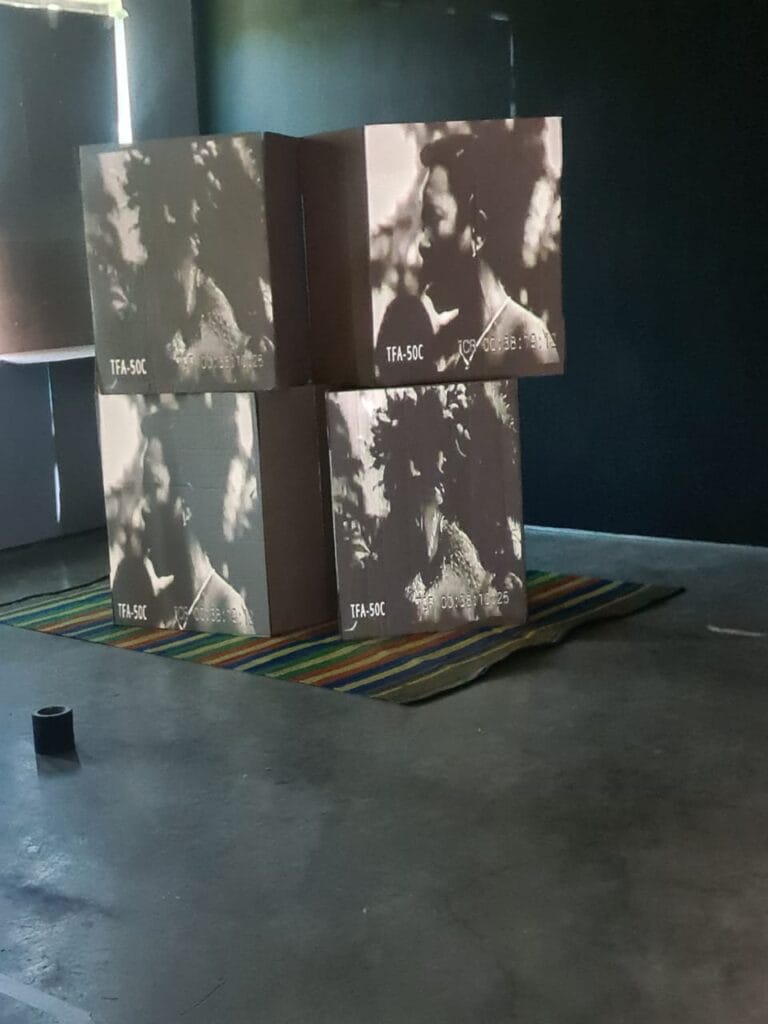
One of my artworks is called The Library of Silence. It’s divided into three female archetypes. One of these is called Lawino and it’s about my search for my grandmother, trying to understand my grandmother’s roots and her experience of womanhood as an independent Kenya was being formed. Lawino comes from Okot P’bitek’s the Song of Lawino, which is poetry we all had to read in school about this woman who is decrying the effects of colonialism on her relationship with her husband and society at large. The second female archetype is called Paulina, which comes from Coming to Birth by Marjorie Oludhe Macgoye, which is another book that we had to read in school. And that’s about a newly post-colonial Kenya, and this woman called Paulina is trying to figure out what it means to be a woman in a nation state that dictates what womanhood looks like. And Paulina is really about trying to understand my mother and her experience of womanhood. And the last archetype is about me trying to understand my womanhood.
So, there’s my grandmother, who knew herself and her roots, who started her own independent African church, and then my mum, who had very different ideas of womanhood from my grandmother and converted to Catholicism and moved to the city. She tried to be this Kenyan woman which didn’t exist before (Kenya didn’t exist before). And then there’s me, who’s kind of trying to reach back to my grandmother. And there is a tension between myself and my mum. You know, my mum is like: “I gave you English names. I took you to Catholic school. I sent you abroad so that you can go deeper into this beast. And you’re coming back instead of going forward.” So, there’s a cycle of womanhood here that I’m interested in. And ultimately, I’m asking: What did colonisation take? What did it give? And what are the things that we can’t really see that it’s done to us?
Andrea: This is fascinating, how you are thinking about who you are in relation to the women in your life, and the broader mechanisms which have shaped these relationships. Have you found this to be an emotional process?
Awuor: Yes, I joke that I have an argument with my mother, and then I make the work. And I have to sit with the emotion. I’m working on a series of paintings called Who Knows Grief, Knows Love. And it’s about the journey that your soul takes after death and I had to do a lot of grief work to be able to do this work, because there’s a lot of grieving for what you think you know and what you think could have been. There’s a version of me that doesn’t exist, right? There’s a version of my mother that doesn’t exist because she had to fit into post-colonial Kenya and its ideas of what a woman is. And I didn’t really know my grandmother. We never spoke the same language, which was a decision that my parents made. They made the decision to move away from our homeland to Nairobi. They made the decision to raise us, and I would say me in particular, in the way that I was raised. I was raised for export really. You’re supposed to leave. And the kind of weird defiance of coming back and being like, no, this is where I want to be. And there’s a lot of grief in all of that. Why did my parents not want me here? And until you understand their reasons, there’s a lot of grief with that. But now I can understand that it was a survival instinct. So, yeah, there’s a lot of emotions.
Andrea: I’d like to hear more about your journey, as an artist and researcher. How did you come to these ideas and these mediums?
Awuor: I think it starts with law school in Birmingham in the UK. My dad wanted me to be a lawyer. The entire time I was there, I was not enjoying it. I started going to art exhibitions and exploring the art scene and doing research on African artists. That was the only thing that kept me alive. Eventually, I realised that I’m not a lawyer, I’m an artist. So, I came back home and I somehow convinced my parents to let me go to art school in Kenya. By the second year, I realised that art school wasn’t the place to really make art, so I left. Eventually, I realised that I like working in a range of mediums. I like pulling things together. But, you know, in Kenya our understanding of art is very broad. So, it makes sense. I want to make the work that I want to make because I want to have conversations with the people I want to have conversations with, right? And that’s why I’m making this work in Kenya, and I’m showing this work to Kenyan audiences, because these are Kenyan conversations. I’m not going to make work that’s not familiar to the Kenyan sensibility of art.
Andrea: And what’s your working process. How did a piece like The Library of Silence come together?
Awuor: A really important element was looking at ethnographic footage and photographs, as it helped me to picture my own grandmother and my mum as young women. When I was looking at these, I was struck by how the women didn’t look “lady like” to me. And I’ve never been “lady like”. I can’t do it. And I thought, maybe it’s in the genetics. Maybe there’s something from my grandmother that passed my mum and is in me. When watching these films, I started to wonder, what narratives were being forced down onto us? In Kenya, in the camps Mau Mau women were taught to crochet and to have tea at 4pm and this is something my own mother forced upon me. There are all these rules she followed. And I hated it. And this was what the British thought women should do, you know. But knowing that the Mau Mau women learnt to crochet and continued to resist, so the British used torture, tells me so much about my mother and the restrictions that she felt.
Anyway, I’m interested in that shift from how my grandmother lived her life and how my mother lived hers. My grandmother was fiercely independent and created her own religious sect. My grandmother didn’t believe in what the British were telling her about Jesus. And then her daughter converted to Catholicism, moved to the city. Through the process of doing this work, I’ve come to understand my mother’s actions as more of her own act of rebellion against her mother, alongside the restrictions that were placed on what her rebellion could be.
Andrea: Yes, it feels like your mum went through her own process of rejecting what was coming from her mother and looking for an alternative and the alternative available to her was this very British sensibility.
Awuor: Yes, and she created a new life for herself in the city. So, these feminine rebellions come in cycles.